

Why Job Oriented Education Matters More Than Degrees Alone
For many students, education begins with a simple goal — to build a stable career. Yet somewhere between classrooms, exams, and certificates, that goal often becomes unclear. Students graduate with degrees but struggle to find roles where they can confidently apply what they’ve learned.
This gap between education and employment is why job-oriented education is becoming increasingly important today.
It shifts the focus from what is taught to how it will be used in real work environments.
The Problem With Theory-Heavy Learning
Traditional education systems often priorities syllabus completion over skill readiness. Students may understand concepts well but feel unprepared when they step into professional settings.
- Difficulty applying classroom knowledge to real tasks
- Lack of exposure to industry tools and processes
- Limited confidence during interviews or initial job roles
This doesn’t mean students lack intelligence or effort. It simply means the learning approach did not align with workplace expectations.
What Job-Oriented Education Actually Means
Job-oriented education is not about shortcut learning or skipping fundamentals. It is about connecting knowledge with real-world application.
Such an approach focuses on:
- Practical skill development alongside theory
- Industry-relevant training methods
- Exposure to real scenarios, not just textbook examples
The goal is to ensure that when students complete their education, they are not starting from zero — they already understand how professional environments function.
Learning With Career Outcomes in Mind
One of the biggest advantages of a job-focused learning approach is clarity. Students know why they are learning something and where it can be applied.
This clarity helps in:
- Better subject understanding
- Improved motivation
- Stronger career direction
Instead of memorizing information only for exams, students begin to see education as preparation for responsibility.
Skill Development Beyond the Classroom
Employers today look for more than academic performance. They value:
- Communication ability
- Problem-solving skills
- Adaptability and professionalism
Job-oriented education naturally builds these traits because students are trained to think beyond marks. Group activities, real case discussions, and applied learning environments prepare them for actual workplace dynamics.
Confidence Comes From Preparedness
Confidence is not a personality trait — it is a result of readiness.
Students who receive practical exposure during their education:
- Perform better in interviews
- Adapt faster in their first job
- Handle responsibilities with less anxiety
They are not guessing what to do. They’ve already practiced it in controlled learning environments.
Reducing the Education-to-Employment Gap
One of the biggest frustrations for graduates is the long adjustment period after getting hired. Job-oriented education shortens this gap.
By the time students enter the workforce:
- Basic workflows feel familiar
- Expectations are clearer
- Learning curves become manageable
This benefits both the student and the employer.
Job-Oriented Medical and Healthcare Courses That Lead to Real Careers
Job-oriented education becomes meaningful when learning directly translates into employability. In the healthcare and allied sectors, certain courses are designed specifically to prepare students for practical roles in hospitals, clinics, diagnostic centers, wellness facilities, and community health organizations.
At our institution, career-focused training is offered across a wide range of medical and healthcare disciplines, allowing students to choose paths aligned with real job opportunities rather than just academic titles.
Key job-oriented courses aligned with employability include:
Paramedical Courses – Designed to prepare students for technical and support roles in hospitals, diagnostic labs, and healthcare facilities through hands-on clinical training.
Nursing Courses – Focused on patient care, clinical procedures, and professional healthcare practices, leading to roles in hospitals, clinics, and home healthcare services.
Community Health Courses – Structured to train students in public health awareness, disease prevention, and community-based healthcare delivery.
Ayurveda Courses – Career-oriented programs that prepare students for roles as Ayurvedic technicians and healthcare support professionals in wellness centers and clinics.
Homeopathy Courses – Designed to build foundational knowledge and practical exposure for work in healthcare settings and pharmacies.
Yoga & Naturopathy Courses – Focused on holistic health practices, wellness therapy, and preventive healthcare roles.
These programs are structured to combine theoretical knowledge with practical exposure, ensuring students graduate with the confidence and skills required to perform in real healthcare environments.
Choosing the Right Learning Path
For students and parents, the focus should shift from degree names to career readiness.
Before selecting an educational path, it is important to ask:
- Does this course build practical skills?
- Will it prepare me for real job responsibilities?
- Does it align with current industry needs?
Education should not just look good on paper — it should work in real life.
A More Responsible Way to Learn
Job-oriented education encourages responsibility. Students understand that learning is not passive. It is preparation for real roles where performance matters.
This mindset change:
- Builds discipline
- Encourages accountability
- Develops long-term professional thinking
Education then becomes a foundation, not a formality.
Final Thoughts on Job-Oriented Education
In today’s competitive environment, degrees alone are no longer enough. What truly matters is how effectively education prepares students for real work responsibilities.
Job-oriented education bridges the gap between learning and earning by emphasizing practical skills, real-world exposure, and professional confidence. It enables students to step into their careers with clarity, readiness, and purpose—rather than uncertainty.
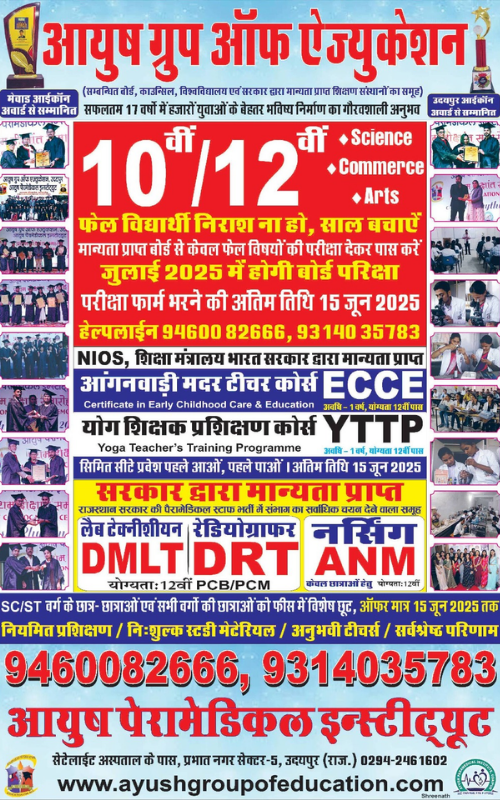
Ayush Group of Education reflects this approach by focusing on career-focused medical and healthcare education. Located in the scenic city of lakes, the institute provides a structured learning environment supported by modern audio-visual teaching tools such as projectors, visualizers, and OHP systems. Through its emphasis on paramedical and nursing courses, the institution equips students with the practical knowledge and hands-on exposure required to build meaningful careers in the medical field.
Known for its academic standards and consistent results, Ayush Group of Education aligns education with employability—ensuring that students don’t just graduate with certificates, but move forward with the skills and confidence needed to succeed in real healthcare environments.
Frequently Asked Questions (FAQs)
1. What is job-oriented education?
Job-oriented education focuses on building practical, industry-relevant skills alongside academic knowledge. It prepares students for real workplace responsibilities by emphasizing hands-on training, applied learning, and professional readiness rather than theory alone.
2. How is job-oriented education different from traditional degree programs?
Traditional degree programs often prioritize theoretical concepts and examinations, while job-oriented education integrates practical exposure, real-world scenarios, and skill-based training. This approach helps students transition smoothly from classrooms to professional environments.
3. Why is job-oriented education important for today’s students?
In a competitive job market, employers seek candidates who can contribute from day one. Job-oriented education reduces the education-to-employment gap by equipping students with confidence, practical experience, and workplace-relevant skills.
4. How does Ayush Group of Education support job-oriented learning?
Ayush Group of Education follows a career-focused approach by combining theoretical instruction with practical training, modern teaching tools, and hands-on exposure in medical and healthcare disciplines. This ensures students graduate with real-world skills and professional confidence.
5. Which job-oriented healthcare courses are offered at Ayush Group of Education?
Ayush Group of Education offers a range of career-focused programs, including paramedical courses, nursing courses, community health programs, Ayurveda, Homeopathy, and Yoga & Naturopathy courses—each designed to align education with employability in healthcare settings.
6. How does job-oriented education improve career outcomes for students?
Job-oriented education helps students perform better in interviews, adapt faster in their first jobs, and handle responsibilities with confidence. By focusing on practical exposure and skill readiness, Ayush Group of Education prepares students for sustainable and meaningful careers in the healthcare sector.
Leave a Reply